

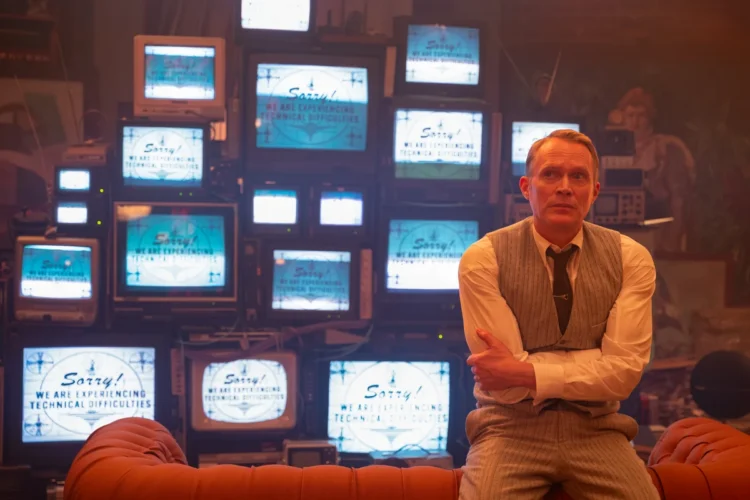
At long last, Marvel has delivered a series about artificial intelligence in which the characters, the house they live in, and the world around them all look as though an algorithm cobbled them together.
Alright, we’re being cheeky. Yes, yes, “VisionQuest” used no generative AI whatsoever. Showrunner Terry Matalas told ScreenRant on a set visit that there “wasn’t really a need,” a pointed contrast with a certain other Marvel series, whose opening titles were made with AI tools back in 2023 and which we have collectively written out of canon ourselves… heh.
But instead of letting a machine do the dreaming, production designer Will Hughes-Jones and his team recreated AI’s most notorious flubs by hand. Stair banisters quit halfway up the staircase, chairs are fused into walls, and fruit and flowers multiply where they have no business being. It’s a joke about AI told entirely by humans, and a good one. The tension between the synthetic and the handmade turns out to be the show’s subtlest party trick.
It has been five years since White Vision flew off at the end of “WandaVision,” taking every question that finale left hanging along with him. “VisionQuest” finally picks up that thread, but in a very different register. Where the first show ran on chaos magic, this one runs on binary, standing in for grief.
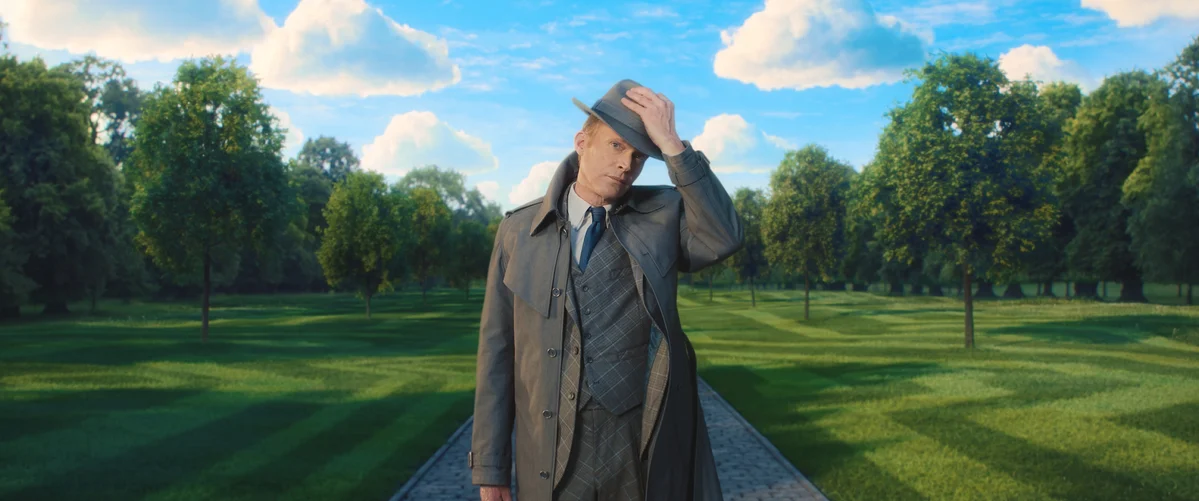
Even after all that time, Vision is still lost in thought, or more accurately, locked inside a prison of his own mind. He has his memories back. Yet, none of the feelings that should come with them, so he keeps circling the question that has trailed him since the Hex fell. Which one is the real Vision? The original who loved Wanda? The blank white weapon SWORD built? Whatever has he become since? It’s the Ship of Theseus all over again.
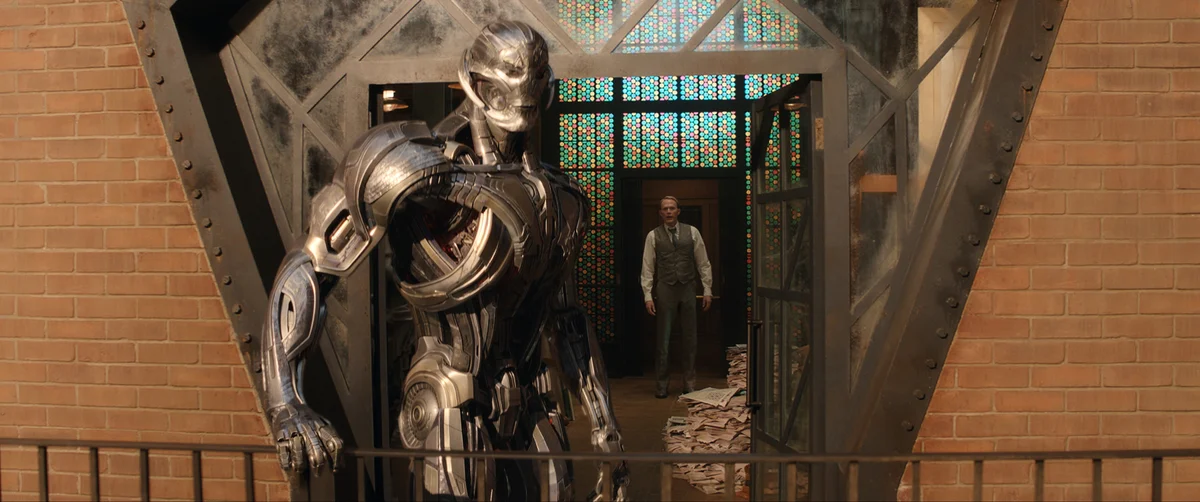
It’s a neat answer to a simple problem: with Wanda gone, who does Vision talk to? The solution plays like an extended encore of the closing Vision-and-Ultron scene in “Avengers: Age of Ultron,” the kind of exchange we always wished had gone on longer. There’s a touch of Pinocchio and Frankenstein in the mix, too,
The result is the Mindspace, a sprawling Victorian-style mansion inside Vision’s head, and it’s a very crowded place. It’s where we meet again the AIs he rescued from the Avengers Compound, and the whole thing plays a bit like “Inside Out,” with every personality running its own department. J.A.R.V.I.S. (James D’Arcy) handles security, housekeeping and encryption, while F.R.I.D.A.Y. (Orla Brady) takes socializing, AI humor and tactical operations. E.D.I.T.H. (Emily Hampshire) oversees recreational AI, game therapy and weapons, which makes her the resident fun expert (and, given that last item, we do wonder why). D.U.M.-E (Henry Lewis) and U (Jonathan Sayer) keep the lights on, with fire suppression for one and videography for the other, since U doesn’t speak. It’s a ridiculous setup on paper, and the show wisely leans into the absurdity instead of apologizing for it.
It also works dramatically. The Mindspace hands Vision what he lost with Wanda: a household of voices, each with its own take on what being human means, and each a sounding board for a man who still doesn’t quite grasp us.
At the center of it all is Bettany, and he’s a joy to watch with the reins in hand. He’s also an executive producer on the show, and the sense of ownership is palpable. He entered the MCU in 2008 as a disembodied voice, J.A.R.V.I.S., and has been working his way toward the middle of the frame ever since. The classically trained actor gets to flex that range again here, and we’re reminded that he can carry an entire series, and an entire head full of AIs, on his shoulders.
And mind you, he does play multiple characters in here, so we’re in for a treat. It’s rather amusing how he indeed has such bubbling chemistry with himself.
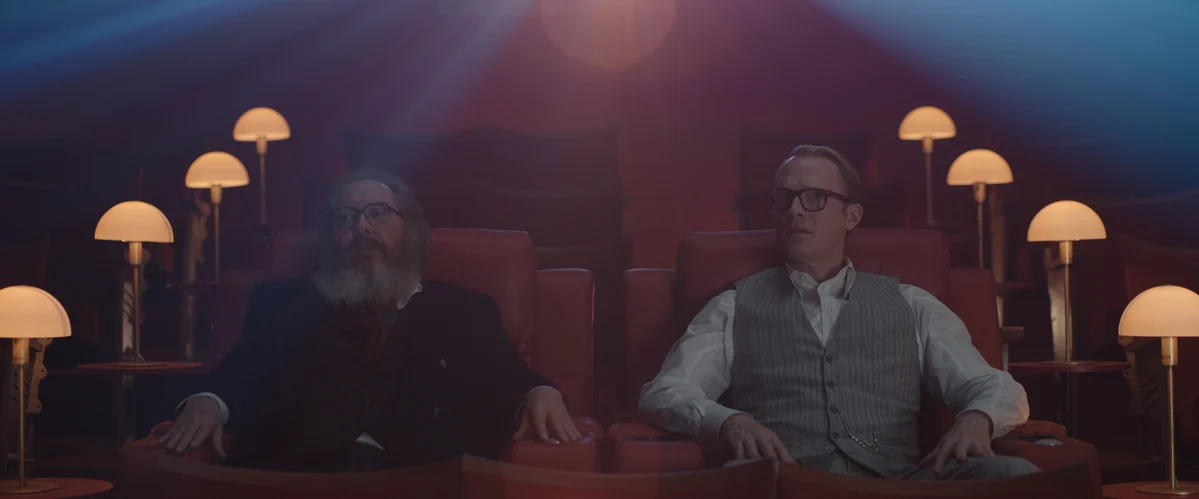
Then there’s Ultron, whom Vision, at a certain crossroads, reaches into the depths of his mind to retrieve: a tiny backup, tucked away all those years ago, that has outlasted everything. The show’s best move is how it chooses to present him. Inside the Mindspace, Ultron isn’t a hulking CGI robot but James Spader himself, human-sized and wild-bearded, draped in long coats and hats (a look Spader reportedly suggested), with a beard that seems to echo Ultron’s metal jaw. It’s a deliberately scruffy image for a character who once threatened humanity’s extinction, and the mismatch is where the fun lives. His grand, theatrical monologues keep colliding with how ordinary he looks delivering them.
Spader, to his credit, layers his trademark sardonic wit over a villain who is still cynical but visibly humbled since his supervillain days. He has described the pair’s bond as “father-son-therapist-psychopath,” which sounds about right. Cut off from the real world, Ultron has to settle for being the devil on Vision’s shoulder rather than a player in his own right, and the series is better for the restriction. He’s less world-ending menace, honestly, than Robert California from “The Office”.
Of course, a hero can’t hide forever. The quiet life Vision has built in Edinburgh is torn apart, rather violently, when the bounty hunter Paladin (Todd Stashwick, of “12 Monkeys” and “Star Trek: Picard”) comes calling on behalf of a mysterious client. He arrives with the ever-quirky Philomena Cunk herself, comedian Diane Morgan, playing his associate. Being hunted gives the show some forward motion, but it’s a modest engine for a cast this sprawling, and the chase never quite carries the weight the Mindspace scenes do.
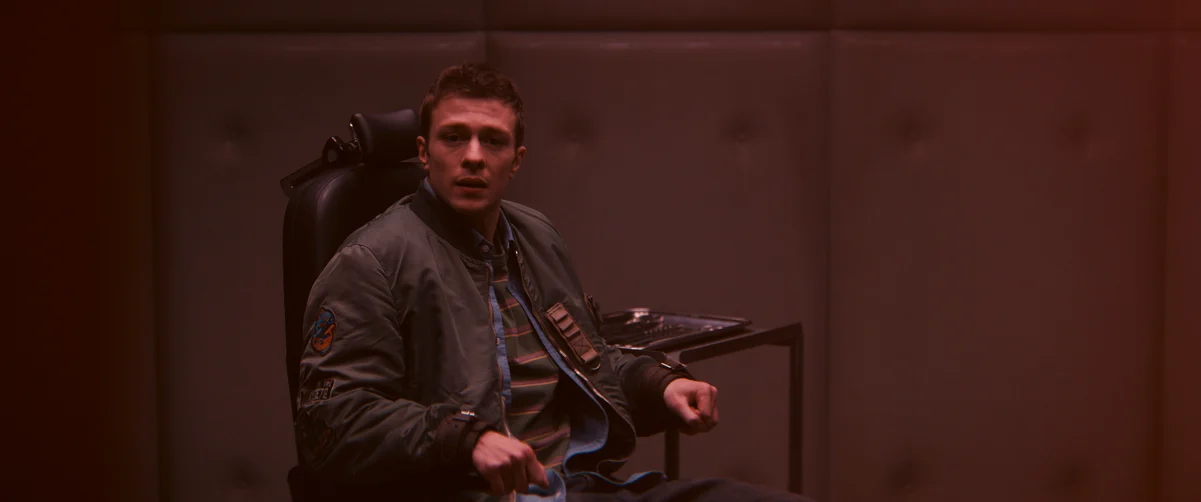
And then there’s Tommy. Ruaridh Mollica is a joy as Thomas Shepherd, the young man carrying Tommy Maximoff’s soul, and he brings a surprising amount of raw feeling to what could have been a purely cerebral drama. Where Bettany and Spader get the big, theatrical beats, Mollica conveys the show’s questions about selfhood and identity in the small moments: a flicker of doubt, a held breath.
But Tommy is also where the show’s ambition starts to strain. He exists only in the physical world, so the constant back-and-forth between it and the Mindspace takes a visible toll on him. His very nature is slippery, too: he’s a sort of echo of the Quicksilver Evan Peters played in “WandaVision,” and yet not quite that character either. That makes him a tricky protagonist to hold on to, and since the show’s whole subject is a being struggling to grasp the irrational fog of human emotion, the confusion clarifies the problem more than it solves it. As Vision wonders what his purpose is without Wanda or the Avengers, so do we.
There is a lot to admire in a show that flutters and flies with its concepts, pairing thoughtful writing with real soul in its characters while fully embracing the fantastical ideas born of its comic book roots. It isn’t about leaning on the flash of its premise. And if you haven’t realized by now that this is also a dig at that other less-than-emerald-ish show, well, now you know.
Still, the series wants to balance its big questions about consciousness against more active storytelling, and the seams show. It tends to tell us what we’re meant to be feeling, and it reaches for familiar chosen-family sentiments to tie its many loose threads together, without always earning the payoff. There’s a second, quieter hurdle, too. In an age when real anxiety about AI is running high, cheering for a household of digital beings takes more effort than the show seems to expect.
So how does it all pan out? Honestly, it’s a step down from both “WandaVision” and “Agatha All Along.” The first show, with its shape-shifting sitcom homage doubling as an allegory for grief, was the first Marvel Studios series on Disney+, and it remains the one to beat in the MCU’s crowded streaming era. “VisionQuest” retraces much of its emotional ground, down to a flashback to that famous line about love, but with a lead who is, by definition, harder to connect with.
It can get messy, and it turns clunky whenever the plot wanders into the real-world machinery around Vision. It’s at its most enjoyable in its comfort zone, zanily tinkering with the Mindspace. Give it time to simmer in its words and wisdom, though, and it’s all good fun, even if it doesn’t leave the lasting mark of its predecessors.

Marvel’s “VisionQuest” is currently streaming on Disney+.