

If you’re a Twitter (X) user, you’ve probably heard about the recent controversy surrounding Grok, the platform’s in-house artificial intelligence (AI) system. Well, the same Grok is now temporarily blocked in Malaysia.
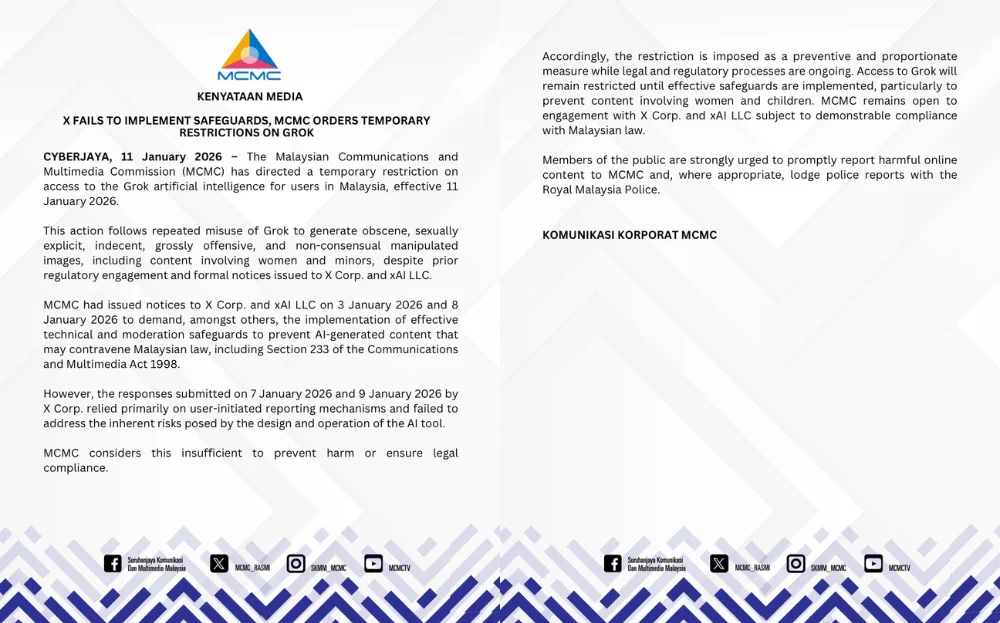
On 11th January 2026 (Sunday), the Malaysian Communications and Multimedia Commission (MCMC) issued a statement announcing that it had temporarily blocked the AI chatbot, effective on that day. The MCMC explained that the move is the result of repeated misuse of the system to generate obscene, sexually explicit, indecent, grossly offensive and non-consensual manipulated images, including content involving women and minors.
From the start of the year, Grok has been the subject of controversy and backlash after Twitter users began using the system to alter images of women and minors on the social media platform. Users would suggest prompts to the AI chatbot to depict women or minors undressed or in minimal clothing, essentially generating deepfakes. These posts understandably caused outrage online for violating the law and human rights.
According to its statement, the MCMC had issued notices to X Corp and xAI LLC, the owners of Twitter and Grok, earlier in the month, demanding the implementation of technical and moderation safeguards to prevent AI-generated content that may contravene Malaysian law. However, the responses submitted failed to address the inherent risks posed by the design and operation of the AI tool.

The MCMC said that the restriction is a preventive and proportionate measure while the legal and regulatory processes are ongoing. Grok will remain blocked in Malaysia until it implements safeguards to prevent content involving women and children. However, the MCMC noted that they’re open to engaging with X Corp and xAI LLC on this matter.
Netizens’ reaction to the ban has been mixed, with some agreeing with the decision and others arguing that Grok isn’t to blame. On the same note, the Indonesian government has also blocked Grok in the country over the same issue, with reports that the United Kingdom may follow suit. What are your thoughts on this?